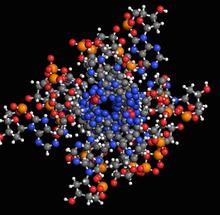
April 25th (4/25) is national DNA day. Digital World Biology™ celebrates by sharing some of our favorite DNA structures. We created these photos with Molecule World™ Molecule World is a tools for exploring molecular and chemical structures on an iPhone or iPad.
Today (4/25) is national DNA day. Digital World Biology™ is celebrating by sharing some of our favorite structures of DNA. We created these photos with Molecule World™ a new iPad app for viewing molecular structures. As we are taught in school, the double stranded DNA molecule is a right-handed helix ...
Scale, proportion, and quantity belong to one of the cross cutting concepts in the next generation science standards (NGSS). According to Volume 2 of the NGSS, "in engineering, no structure could be conceived much less constructed without the engineer's precise sense of scale." The authors go on to note that ...
Instead of enjoying a sunny summer day today, or partying with SciBlings in New York, I'm staring out my window watching the rain. Inspiration hit! What about searching for August? Folks, meet the HFQ protein from E. coli. I found this lovely molecule by doing a multi-database search at the ...
Pull a spaghetti noodle out of a box of pasta and take a look. It's long and stiff. Try to bend it and it breaks. But fresh pasta is pliable. It can fold just like cooked noodles. When students first look at an amino acid sequence, a long string of ...
When can a really bad virus be used to do something good? When we can use it to learn. The human immunodeficiency virus, cause of AIDS, scourge of countries, and recent focus of ScienceBlogs; like humans, evolves. As one of my fellow ScienceBloggers noted, few biological systems demonstrate evolution as ...
Did HIV become resistant to Atazanavir because of a genetic change? Was that genetic change inherited? Did HIV evolve? Can we explain why genetic changes at specific sites might help HIV escape the effects of the drug? Let's find out. All of the sequences in the image below (except for ...
Want to learn more about Parkinson's disease? See why a single nucleotide mutation messes up the function of a protein? I have a short activity that uses Cn3D (a molecular viewing program from the NCBI) to look at a protein that seems to be involved in a rare form of ...
How can you win a nerd contest if you don't dress the part? Last year, I started a shop at CafePress to help distribute lab materials and fund my adventures in science education. Part of the fun has been making molecular merchandise to help show everyone that molecular models are ...
Replication fork - https://en.wikipedia.org/wiki/Telomere. Organisms with linear chromosomes have to solve the problem that DNA replication makes them shorter. This is due to the fact that DNA polymerase can only add bases to the terminal 3'-OH of a DNA chain. The DNA replication initiation complex uses RNA primers to provide ...
Replication fork - http://en.wikipedia.org/wiki/Telomere.
Every time their DNA gets replicated, it gets shorter. This is due to the fact that DNA polymerase can only add bases to the terminal 3'-OH of a DNA chain. The DNA replication initiation complex uses RNA ...
and what is the volume of the sea? This sounds a bit like the beginning of a poem but it's really the answer to the question we posed last week on a Digital Biology Friday. We can see, in the sequence window, that two strands are both labeled 5' on ...
It's been interesting to watch as microbiology's own cold fusion debate has been raging. It began with an extraordinary claim about bacteria using arsenate as a replacement when phosphate concentrations are low (1). It progressed when at least two scientist / bloggers ( here, and here) ( not bloggers! the ...
Sucrose Molecules of sucrose tore apart in their bellies letting glucose course free in their veins. Luckily for us, a system evolved long ago to capture that glucose and minimize it's potential for damage. Removing sugar from the blood and sequestering it in liver, fat, and muscle cells, minimizes the ...
Lots of bloggers in the DNA network have been busy these past few days writing about Google's co-founder Sergey Brin, his blog, his wife's company ( 23andme), and his mutation in the LRRK2 gene. I was a little surprised to see that while other bloggers ( here, here, here, and ...